
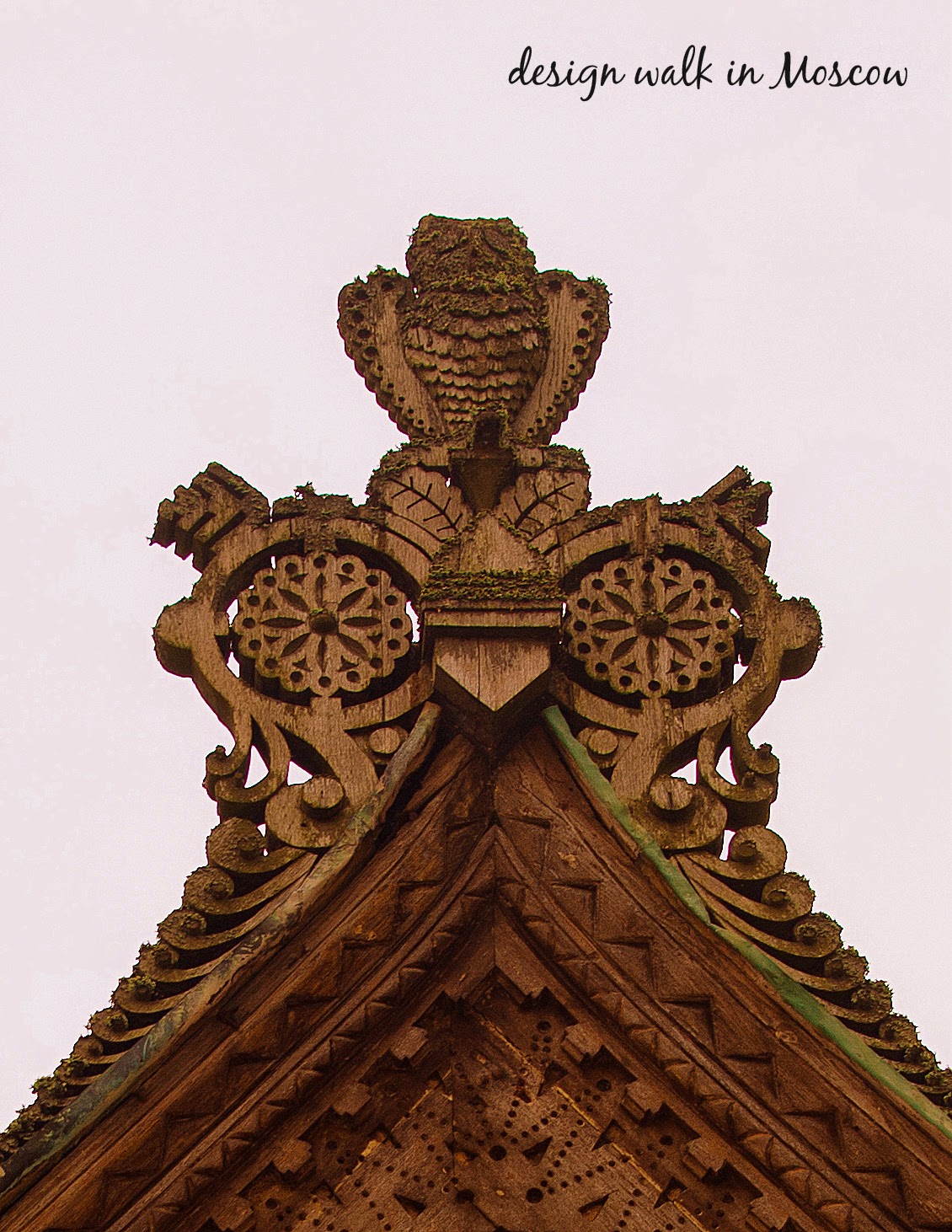
Hi there, I got a bad cold, it's been a long time since my last post. I continue the report from Abramtshevo. This time, you will find a lot of lovely "Owls" in my pictures. Now you see the first one, on the top of the entrance roof.
前回のアブラムツェボ紹介から日が経ってしまいましたが、つづき。
今回は写真の中に、何羽のかわいい「ふくろうさん」を見つけることができるでしょうか?がポイント。さっそく一羽目が見えてきましたよ。ほら、よく見ると玄関屋根のてっぺんに。
This house is called "Bathhouse" (buit in 1878). The triangle shaped roof is painted in red black check patterns, this fanciful look reminds us of a dwarf house in fairy tales. This building is definitely the highlight of Abramtsevo museum, designed by Ivan Ropet who was the originator of the Russian Revival in architecture. The decoration above the porch, like a big barrel gives us unique impression,it resembles the old Russian architectures.
この建物はBathhouse (1878年)。木々に囲まれたチェック模様の三角屋根は、まさしくおとぎの国の小人のお家みたい。アブラムツェボ・ミュージアムの中で、間違いなくハイライトでしょう。デザイナーはIvan Ropet, ネオロシアスタイルの第一人者と敬われる建築家です。玄関上の大きな樽上の装飾が、中世ロシアの伝統的建築を想起させます。

The estate owner, Mamontov used this house for the private porpose and later it became a rest house. Its interior is also fantastic. There are two main rooms, one is the dining room with beautiful wooden furniture which is decorated by Russian traditional carving. And I found the cute "owl"design on the lampshade. I wish I could take them my home!! The other room is designed by Ivan Ropet. It is a perfect example of Russian Design! Every part is carefully carved by Russian traditional way. The log walls and window flames remains original wood color, light beige. In contrast, the ceiling and the ceramic stove is light blue. This color combination makes this small room something special.
オーナーMamontov氏が私用で使っていたというBathhouse、インテリアも期待を裏切りません。大きく2つの部屋にわかれ、一部屋はダイニングセットのような家具が設置されていますが、そのどれもが美しい純ロシア風の木彫りで装飾されています。そして目をひくのが、可愛らしい「ふくろう」のランプシェード。これは自宅にも飾りたい!
もう一つの部屋は、Ivan Ropetデザイン。完成度の高い「ロシアンデザイン」に圧倒されます。白木っぽい木の壁と窓枠の彫刻は繊細で美しく、天井とペチカの冴えわたったブルーとのコントラストが見事です。細部まで丁寧な仕事ぶりがうかがえます。

The Russian famous fairy tale painter, Vicktor Vasnetsov (also see my previous post) left two architectual works in Abramtsevo museum. Firstly, "Hut on Chicken legs"(1883). This odd idea came from the Slavic fork tale, the supernatural being Baba Yaga usually described as living in the hut on chicken legs. The hut built in Abramtsevo didn't have legs though. The decoration around the roof, at one side there is the Owl motif, the other side is the Bat, and the roof top crowns the horse head. The second building by V.Vasnetsov is "Church of the savior"(1882). Unfortunately it is being restored now. We could only see the part of beautiful decoration by colorful tiles.
ロシアのおとぎ話を描く画家といえば、Viktor Vasnetsov (過去投稿)。彼のプロジェクトによる建築が2作品ここに残されています。まずはHut on Chicken Legs(鶏の足の上に立つ小屋 1883年)。スラブ民話の妖婆、バーバ・ヤーガが住んでいたのが鶏の足の上に立つ家なのです。実際、アブラムツェボの小屋は足のようにはなっていません。屋根付近の装飾には居ました「ふくろう」!!反対側には「こうもり」。そして屋根てっぺんには馬頭が乗っかっています。V.Vasnetsov2つ目の作品は、救世主教会(1882年)です。残念ながら現在修復中。しかし外壁の一部にみられる色鮮やかなタイルの装飾から、Vasnetsovのこだわりが感じられます。

Lastly I want to show you, "Kitchen"(1870) which was built as the previous estate owner Aksakov's kitchen. The building apperance is not as unique as others, well seen in a sort of forklore museums. However, today it keeps the excellent collection of Russian peasant art works, such as spinning wheels, decorative wooden boxes and so on. The wooden ladles collection is remarkably large numbers and the variety of handle decoration is worth to see.
最後に紹介したいのはKitchen(1870年)。旧オーナーAksakov氏の台所として建築されました。小屋自体は民俗博物館でよく見かけるような平凡なデザインです。ただ内部の展示物は見ごたえがあります。ロシア農民文化に関するコレクションは、紡ぎ機や飾り箱のバリエーション、保存状態がたいへん良いです。特に木製ひしゃくのコレクションは数が揃っており、それぞれ柄部分のデザインが楽しめるでしょう。


Abramtsevo, the ideal village created by 19C Russian artists. It is exactly a Russian world in my imagination, more than the real . It is the wonderland where Russian traditional culture has revived with artists' new ideas. From Moscow, it takes only 2 hours by train, visit and say 'Hi' to these cute owls, they always welcome you.
19世紀のアーティスト達が作り上げた理想郷アブラムツェボは、現実のロシアより「ロシアらしさ」が凝縮されており、異国から来た私を満足させてくれました。アーティスト達が、伝統を模しながら遊び心を持ってアレンジしたような不思議の世界です。愛嬌のある「ふくろうさん」たちに、ぜひ会いに行ってください。

For your information:
Abramtsevo state cultural establishment artistic and literary museum-reserve
English guide is available, but advance booking is necessary.
address
141352, Московская обл., Сергиево-Посадский муниципальный район,
городское поселение Хотьково, c. Абрамцево, ул. Музейная, д. 1
前回のアブラムツェボ紹介から日が経ってしまいましたが、つづき。
今回は写真の中に、何羽のかわいい「ふくろうさん」を見つけることができるでしょうか?がポイント。さっそく一羽目が見えてきましたよ。ほら、よく見ると玄関屋根のてっぺんに。
 |
| Bathhouse (1878) designed by Ivan Ropet |
This house is called "Bathhouse" (buit in 1878). The triangle shaped roof is painted in red black check patterns, this fanciful look reminds us of a dwarf house in fairy tales. This building is definitely the highlight of Abramtsevo museum, designed by Ivan Ropet who was the originator of the Russian Revival in architecture. The decoration above the porch, like a big barrel gives us unique impression,it resembles the old Russian architectures.
この建物はBathhouse (1878年)。木々に囲まれたチェック模様の三角屋根は、まさしくおとぎの国の小人のお家みたい。アブラムツェボ・ミュージアムの中で、間違いなくハイライトでしょう。デザイナーはIvan Ropet, ネオロシアスタイルの第一人者と敬われる建築家です。玄関上の大きな樽上の装飾が、中世ロシアの伝統的建築を想起させます。
The estate owner, Mamontov used this house for the private porpose and later it became a rest house. Its interior is also fantastic. There are two main rooms, one is the dining room with beautiful wooden furniture which is decorated by Russian traditional carving. And I found the cute "owl"design on the lampshade. I wish I could take them my home!! The other room is designed by Ivan Ropet. It is a perfect example of Russian Design! Every part is carefully carved by Russian traditional way. The log walls and window flames remains original wood color, light beige. In contrast, the ceiling and the ceramic stove is light blue. This color combination makes this small room something special.
オーナーMamontov氏が私用で使っていたというBathhouse、インテリアも期待を裏切りません。大きく2つの部屋にわかれ、一部屋はダイニングセットのような家具が設置されていますが、そのどれもが美しい純ロシア風の木彫りで装飾されています。そして目をひくのが、可愛らしい「ふくろう」のランプシェード。これは自宅にも飾りたい!
もう一つの部屋は、Ivan Ropetデザイン。完成度の高い「ロシアンデザイン」に圧倒されます。白木っぽい木の壁と窓枠の彫刻は繊細で美しく、天井とペチカの冴えわたったブルーとのコントラストが見事です。細部まで丁寧な仕事ぶりがうかがえます。
 |
| The interior of Bathhouse |
 |
 |
| The interior designed by Ivan Ropet |
The Russian famous fairy tale painter, Vicktor Vasnetsov (also see my previous post) left two architectual works in Abramtsevo museum. Firstly, "Hut on Chicken legs"(1883). This odd idea came from the Slavic fork tale, the supernatural being Baba Yaga usually described as living in the hut on chicken legs. The hut built in Abramtsevo didn't have legs though. The decoration around the roof, at one side there is the Owl motif, the other side is the Bat, and the roof top crowns the horse head. The second building by V.Vasnetsov is "Church of the savior"(1882). Unfortunately it is being restored now. We could only see the part of beautiful decoration by colorful tiles.
ロシアのおとぎ話を描く画家といえば、Viktor Vasnetsov (過去投稿)。彼のプロジェクトによる建築が2作品ここに残されています。まずはHut on Chicken Legs(鶏の足の上に立つ小屋 1883年)。スラブ民話の妖婆、バーバ・ヤーガが住んでいたのが鶏の足の上に立つ家なのです。実際、アブラムツェボの小屋は足のようにはなっていません。屋根付近の装飾には居ました「ふくろう」!!反対側には「こうもり」。そして屋根てっぺんには馬頭が乗っかっています。V.Vasnetsov2つ目の作品は、救世主教会(1882年)です。残念ながら現在修復中。しかし外壁の一部にみられる色鮮やかなタイルの装飾から、Vasnetsovのこだわりが感じられます。
 |
| Hut on Chicken legs(1883), designed by Viktor Vasnetsov |
 |
| V.Vasnetsov's original plan |
 |
| The church of the savior(1882, designed by Viktor Vasnetsov |
Lastly I want to show you, "Kitchen"(1870) which was built as the previous estate owner Aksakov's kitchen. The building apperance is not as unique as others, well seen in a sort of forklore museums. However, today it keeps the excellent collection of Russian peasant art works, such as spinning wheels, decorative wooden boxes and so on. The wooden ladles collection is remarkably large numbers and the variety of handle decoration is worth to see.
最後に紹介したいのはKitchen(1870年)。旧オーナーAksakov氏の台所として建築されました。小屋自体は民俗博物館でよく見かけるような平凡なデザインです。ただ内部の展示物は見ごたえがあります。ロシア農民文化に関するコレクションは、紡ぎ機や飾り箱のバリエーション、保存状態がたいへん良いです。特に木製ひしゃくのコレクションは数が揃っており、それぞれ柄部分のデザインが楽しめるでしょう。
 |
| Kitchen(1870) |
 |
| Russian peasant houseware collection |
Abramtsevo, the ideal village created by 19C Russian artists. It is exactly a Russian world in my imagination, more than the real . It is the wonderland where Russian traditional culture has revived with artists' new ideas. From Moscow, it takes only 2 hours by train, visit and say 'Hi' to these cute owls, they always welcome you.
19世紀のアーティスト達が作り上げた理想郷アブラムツェボは、現実のロシアより「ロシアらしさ」が凝縮されており、異国から来た私を満足させてくれました。アーティスト達が、伝統を模しながら遊び心を持ってアレンジしたような不思議の世界です。愛嬌のある「ふくろうさん」たちに、ぜひ会いに行ってください。
For your information:
Abramtsevo state cultural establishment artistic and literary museum-reserve
English guide is available, but advance booking is necessary.
address
141352, Московская обл., Сергиево-Посадский муниципальный район,
городское поселение Хотьково, c. Абрамцево, ул. Музейная, д. 1


